
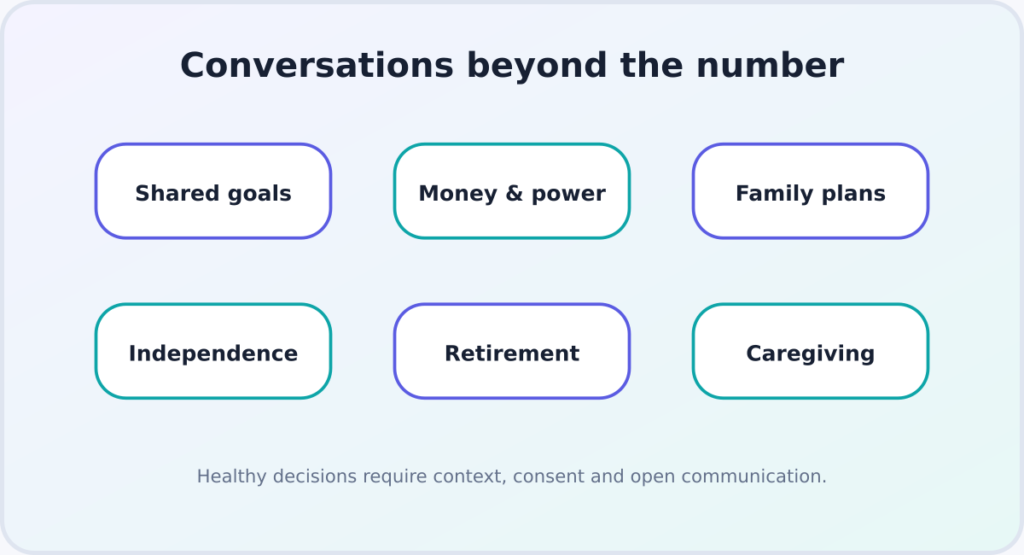
1. What does commitment mean to each of us?
Define exclusivity, marriage expectations and the pace of the relationship instead of relying on assumptions.
2. Do we want children?
Discuss desire, timing, fertility realities, adoption and existing children.
3. How will money and power work?
Talk about income differences, debt, ownership, financial privacy and decision rights.
4. What are our career and location plans?
Clarify relocation, study, entrepreneurship and retirement timelines.
5. How will we handle family and public reactions?
Agree on boundaries and decide which relationships deserve explanation.
6. What might caregiving look like?
Discuss health history, disability, insurance and long-term support without assuming one person’s role.
7. Can both people remain independent?
Healthy closeness should coexist with friendships, privacy, personal goals and the freedom to disagree.
How to have these conversations
Choose a calm time, discuss one topic at a time and use concrete scenarios. Replace “You will probably…” with “How would we handle…?” The goal is not to win agreement immediately but to reveal assumptions early.
Document practical decisions
For money, housing, caregiving and estate plans, verbal understanding may not be enough. Written budgets, beneficiary reviews and professional agreements can prevent confusion.
Revisit the answers
Plans should be reviewed after major events such as a job change, marriage, birth, diagnosis, relocation or retirement. Life-stage differences evolve, so one conversation is not a permanent solution.
When disagreement is meaningful
Not every difference requires separation. However, unresolved conflict about children, consent, control, finances or basic safety should not be minimized as an “age-gap issue.” Those are substantive relationship questions.
A simple conversation framework
Begin with facts, move to preferences and finish with decisions. For example: “Our likely retirement dates are ten years apart” is a fact. “I want us to travel while we are both working” is a preference. “We will review our savings plan every January” is a decision. Keeping these layers separate reduces vague arguments.
Questions about money
- What income, debt and savings does each person have?
- Which expenses are shared, and which remain individual?
- Can both partners see important accounts and documents?
- What happens if one person stops working first?
Questions about family and care
Discuss children, fertility, relationships with adult children, elder care and who may need support. Avoid promises made only to end an uncomfortable conversation. A genuine difference about having children cannot be solved by treating it as a minor age-gap concern.
Questions about identity and independence
Each person should retain friends, interests, privacy and the ability to seek advice. Ask how you will respond if one social circle feels uncomfortable or if one partner becomes dependent on the other for money, transport or immigration status.
Frequently asked questions
When should these conversations happen?
Before major commitments, and again when work, health, family or housing changes.
What if we cannot agree?
Identify whether the issue allows compromise. Children, safety and coercive control are not topics where one person should be pressured into surrendering a boundary.
Would counseling help?
A qualified, neutral professional can help couples discuss recurring conflict, provided both people can participate freely and safely.